
Shipping diagnostic samples: a practical guide
Getting samples through the system means meeting the transport rules and the requirements of your carrier, at the lowest sensible cost. This guide sets out the essentials for UN3373 Biological Substance, Category B.
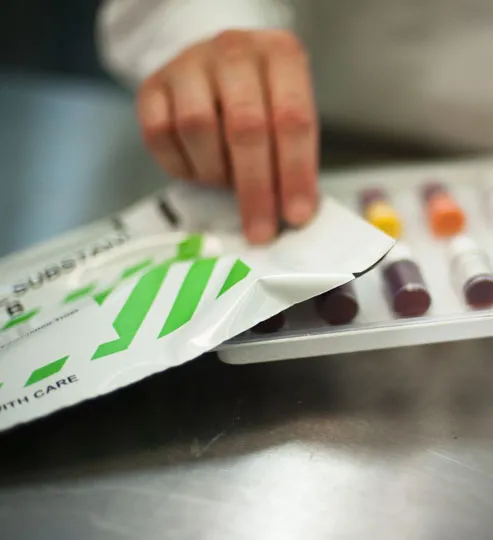
This is a summary to help you plan, not legal advice. The regulations are revised regularly (ADR every two years, the IATA rules every year), so always check the current edition, your carrier's conditions and, where you have one, your dangerous goods safety adviser.
Which rules apply
Most diagnostic specimens, such as blood, urine and swabs taken for testing, are classed as UN3373 Biological Substance, Category B: material that may contain pathogens but not in a form that could cause permanent disability or life-threatening disease in otherwise healthy people. The packaging rules for Category B are set out in one packing instruction, applied by each mode of transport:
| Transport | Regulations | Packing instruction |
|---|---|---|
| Road | ADR | P650 |
| Rail | RID | P650 |
| Sea | IMDG Code | P650 |
| Air | ICAO Technical Instructions and IATA Dangerous Goods Regulations | PI650 |
Specimens with only a minimal likelihood of containing pathogens can travel as exempt specimens (see common questions). Category A infectious substances are outside the scope of this guide.
Triple packaging under P650
Every UN3373 package is made of three layers, with absorbent between the first two when the samples are liquid, and the complete package must be able to pass a 1.2 metre drop test.
- Primary receptacle. The tube, vial or pot that holds the sample. It must be leak-proof for liquids or sift-proof for solids. Several fragile primaries in one secondary must be wrapped or separated so they cannot touch. Primary containers
- Absorbent material. For liquids, placed between the primary and secondary, in enough quantity to absorb the entire contents of all the primaries. Super absorbent pads, Thermacor, SAP cores
- Secondary packaging. A leak-proof (or sift-proof) layer around the primaries. FS95 pouches, Thermacor
- Outer packaging. Strong enough for its capacity, mass and intended use, with at least one surface measuring 100mm by 100mm or more. Either the secondary or the outer packaging must be rigid. Rigid outers, flexible outers
For air transport, either the primary or the secondary packaging must also withstand a pressure differential of at least 95kPa without leaking. Our RF95 system brings all of these layers together in one flat-packed kit.
Marking and documents
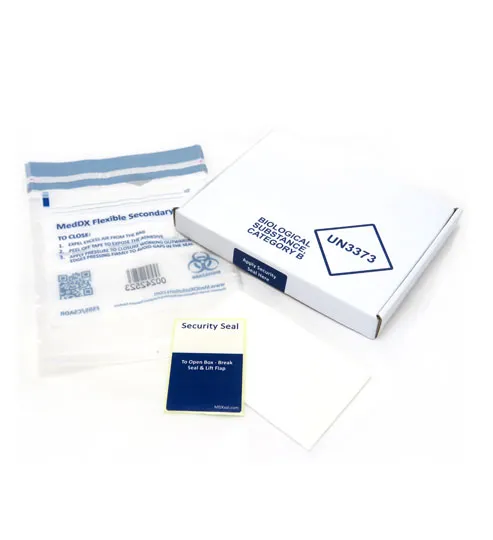
- The outer packaging carries the UN3373 diamond mark: a square set at 45 degrees, at least 50mm by 50mm, with a line at least 2mm wide and the letters and numbers at least 6mm high.
- The words "BIOLOGICAL SUBSTANCE, CATEGORY B", in letters at least 6mm high, appear next to the diamond.
- An itemised list of contents goes between the secondary and the outer packaging.
- For air transport, the name and telephone number of a person responsible for the shipment must be on the air waybill or on the package.
All our printed outers, the MedDXTAINER and our transport systems carry the required UN3373 markings, and we can add your return address, Freepost or Business Reply details.
Sending by post
Royal Mail accepts UN3373 Biological Substance, Category B within the UK when it is packed and marked to P650 and meets Royal Mail's own conditions, which can change. Check its current prohibited and restricted items guidance before you start a postal programme, and note that international post is far more restricted.
Size has a big effect on postage. Our flexible outers often qualify for large letter rates, the RO/LL1 and RF95/LL1 are sized as large letters (194 x 147 x 24mm), and our other outers are designed around small parcel sizes. We can print your Royal Mail Freepost or Business Reply details so patients can return kits easily.
Sending by courier and air
Couriers, including specialist medical couriers, set their own acceptance rules for UN3373, so agree the packaging with your carrier before you ship. Most price on volumetric weight, which is why our outer sizes are chosen to fit common volumetric bands, such as the 1kg band for the RIO/1K insulated shipper.
If a package may travel by air, PI650 applies: use 95kPa primaries or a 95kPa secondary such as FS95, and keep to the air quantity limits (for liquids, no more than 1 litre per primary receptacle and 4 litres per package; for solids, 4kg per package, with some exceptions).
For temperature-sensitive samples, insulated options such as the RIO/1K and the MedDXTAINER EPP liner work with gel packs. Dry ice is a dangerous good in its own right (UN1845): the package must let carbon dioxide gas escape and carry the extra dry ice marking, and dry ice must never go inside the secondary packaging.
Common questions
Do I need 95kPa packaging if my samples only travel by road or post?
The 95kPa pressure requirement comes from the air rules (PI650). For road transport under ADR it is not required, but many senders use a 95kPa primary or secondary anyway, because packages can end up on aircraft and one pack that works for every route keeps things simple. Our FS95 pouches and 95kPa primary containers cover both.
How much absorbent do I need?
Enough to absorb the entire liquid contents of all the primary containers in the package. Our super absorbent pads are rated by blood absorbent capacity (50ml to 400ml), so pick a sheet whose capacity at least matches the total volume you are shipping.
What is an exempt specimen?
Patient specimens with a minimal likelihood of containing pathogens, based on professional judgement, can be sent as an "Exempt human specimen" or "Exempt animal specimen". They are not subject to UN3373, but they still need triple packaging: a leak-proof primary, a leak-proof secondary, a suitably strong outer and, for liquids, enough absorbent. The outer is marked with the matching words instead of the UN3373 diamond.
Can I use your products for Category A infectious substances?
No. Our standard range is designed for UN3373 Biological Substance, Category B and for exempt specimens. Category A substances (UN2814 and UN2900) need UN-specification packaging under packing instruction P620 and different documentation.
Can I refurbish and reuse kits?
Yes, with the right components. Our rigid outers suit refurbishment systems, and we offer kit refurbishment as part of kit fulfilment. Check each component before reuse, and replace single-use items such as secondary pouches, absorbents and security seals.
Official sources
- GOV.UK: Moving dangerous goods (opens in a new tab)UK rules for carrying dangerous goods by road, rail, sea and air.
- HSE: Carriage of dangerous goods (opens in a new tab)Health and Safety Executive guidance, including dangerous goods safety advisers.
- UNECE: ADR (opens in a new tab)The European agreement on the carriage of dangerous goods by road, including P650.
- IATA Dangerous Goods Regulations (opens in a new tab)The air transport rules, including packing instruction PI650.
- WHO: Guidance on regulations for the transport of infectious substances (opens in a new tab)A clear international overview of Category A, Category B and exempt specimens.
- Royal Mail (opens in a new tab)Search "prohibited and restricted items" for current conditions on posting biological substances.
Not sure what your shipment needs?
Tell us what you are sending, how and where. We will help you work through the requirements and recommend packaging that is compliant and cost-effective.
Ask our team